




Empirical economic research is becoming increasingly important within the economic sciences. Current debates on the causes and consequences of social and economic developments as well as on the orientation of economic policy are increasingly based on the results of empirical research. In the Competence Field Empirical Economic Research (EWF), around one hundred researchers from the three UA Ruhr universities and RWI - Leibniz Institute for Economic Research, as well as roughly the same number of doctoral students, are currently working on topics relevant to empirical economic research. The strategic goal of this cooperation is to establish the competence field EWF as an internationally visible center for empirical economic research by bundling excellent research.
The EMF competence field embeds the diverse competencies already existing at the participating institutions in the fields of applied empirical economic research, methodological development and scientific policy advice into a common framework, thereby enabling them to be better interlinked and thus to exploit complementarities across locations. Scientists from the three economics faculties at the UAR, the only statistics faculty in Germany at the TU Dortmund University, and the RWI - Leibniz Institute for Economic Research in Essen work closely together on this project. In addition, the Ruhr Research Data Center at RWI provides a large number of data sets for empirical research.
All researchers involved apply econometric methods in the empirical analysis of economic contexts and develop them further in a problem-related manner. The fields of application cover a broad spectrum of economic sciences. The resulting diversity of applications and methods makes it possible to create high synergies within the field of competence. Research areas of the competence field include labor, health, energy and climate, and investment.
Perspectives in empirical economic research
The research collective pooled here applies econometric methods from three overarching perspectives. The first perspective is the microeconomic view ("micro"). It analyzes legal and natural individuals and thus captures the behavior of people or firms and their interaction in households or industries typically in a bottom-up approach. Aggregating economic actors sufficiently, one arrives at the macroeconomic perspective ("macro"), which addresses the question of how these aggregates affect each other and each other (top-down).
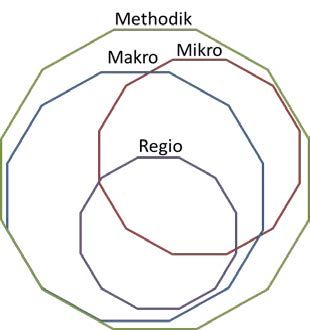
Microeconomics and macroeconomics together represent the classical field of economics as the science that deals with human behavior in terms of alternative uses in the face of limited resources. Numerous issues in both fields have spatial aspects, spanning the entire spectrum from local to global spaces, and represent an independent level of analysis ("regio") due to their high importance for economic activity, political processes and social identity. Common to all three perspectives is the use of data to answer their respective research questions. Another core activity is therefore the Ruhr Research Data Center at RWI to collect and process data sets and make them available to the scientific community. Quantitative analysis decisions require comprehensive knowledge of statistical methods as well as their methodological adaptation or further development on a case-by-case basis. Therefore, methodologically working scientists complete the work of the competence field in a fourth methodological perspective. This perspective aims at adapting and further developing the statistical methods necessary for these analyses, based on the content-related questions of economics and social sciences and the resulting demands on the informative value of the methodological approaches.
With the competence field EWF, the relevant activities are brought together under a common umbrella, thus achieving an increased international visibility. Existing activities will be coordinated and further cooperation will be generated. The competence field thus also serves as a nucleus for further joint projects. Current joint projects are listed below.
Economic Ethics Commission of the University Alliance Ruhr and RWI
Research projects in economic research increasingly use experimental methods and survey techniques that rely on human participation as test subjects or interview partners. The Faculty of Business and Economics at TU Dortmund University, the Faculty of Economics at Ruhr-University Bochum, the Faculty of Business Administration and Mercator School of Management at the University of Duisburg-Essen, and the RWI – Leibniz Institute for Economic Research recognize the unique relationship between researcher and participant, along with the associated responsibilities. They ensure that the dignity and integrity of participants are maintained throughout the research. All appropriate measures are taken to protect the well-being of research participants and to eliminate any individual risks associated with their involvement.
In this context, the participating institutions have established a joint commission, which researchers from the affiliated faculties and RWI can consult to assess the ethical aspects of their research. This body is named the "Economic Ethics Commission of the University Alliance Ruhr and RWI" (hereafter referred to as the Commission). The Commission exclusively focuses on evaluating the ethical aspects of research projects conducted or supervised by researchers within this field.
Please Note
- Only members of the Faculty of Business and Economics at TU Dortmund University, the Faculty of Economics at Ruhr-University Bochum, the Faculty of Business Administration and Mercator School of Management at the University of Duisburg-Essen, and the RWI – Leibniz Institute for Economic Research may submit applications.
- Applications can only be submitted before the start of the study or experiment.
- Research projects involving invasive or medical procedures cannot be reviewed by this Commission. In such cases, applications must be submitted to the Ethics Commission of the Medical Faculty.
- Two forms are available for application submission:
- First, check if your research project requires an ethical review at all. Please use this checklist for guidance. If you can answer all questions with “no,” send the signed checklist to Thomas.Bauer@rwi-essen.de. You will then receive a letter of no objection from the Commission.
- If you answer one or more questions with “yes” or “unsure,” please complete the application form and send it with the required documents to the above email address. Please refer to the guidelines for submitting the application when completing your application.
Members
- Prof. Dr. Thomas K. Bauer (Ruhr-University Bochum and RWI)
- Dr. Gerrit Köchling (TU Dortmund University)
- Prof. Eugen Kovac, Ph.D. (University of Duisburg-Essen)
- Prof. Dr. Martin Nienhaus (Ruhr-University Bochum)
- Prof. Dr. Sebastian Otten (University of Duisburg-Essen)
- Prof. Dr. Peter N. Posch (TU Dortmund University)
- Prof. Dr. Joachim Prinz (University of Duisburg-Essen)
- Philip Raatz (RWI)
- Prof. Dr. Jürgen Wasem (University of Duisburg-Essen)